In Ghana, WhatsApp is not one channel among many. It is where the conversation happens, where people ask "how much?", and where they decide whether to trust you enough to send money.
So selling on WhatsApp is not a beginner step you graduate from. It is the main thing, and it is worth doing properly.
This guide covers the setup, the conversation, getting paid, and the part most articles leave out, which is exactly where WhatsApp on its own starts costing you sales.
Set Up WhatsApp Business Properly
If you are selling from a personal WhatsApp account, switch. WhatsApp Business is free, it keeps your chats, and it adds tools built for exactly this.
Fill in the whole profile. Business name, category, a real description of what you sell, your location, your hours, and a link. Buyers check this before deciding whether you are real, and an empty profile costs you sales you never hear about.
Build your catalogue. Under Settings, then Business tools, then Catalogue, you can add products with photos, prices and descriptions. Customers browse without asking you to send pictures one at a time.
Write your quick replies. Save the answers you type twenty times a day. Delivery charges, payment details, sizes, how long delivery takes. Type a shortcut, send a full answer.
Set up labels. New customer, paid, to deliver, delivered, follow up. Labels are the closest WhatsApp gets to order management, and without them you will lose track once you pass a handful of orders a day.
Add a greeting and away message. Someone messaging at 11pm should know when you will reply. Silence reads as unreliable.
Get a Click-to-Chat Link
Nobody should have to save your number to message you. A click-to-chat link opens a chat directly, and you can pre-fill the first message so the conversation starts properly.
Put it in your Instagram bio, your TikTok profile, your status, and on your flyers.
You can make one free with our WhatsApp link generator. No signup, and you can pre-fill something like "Hi, I saw your page and I am interested in..." so you immediately know where the person came from.
Understand the Two Rules That Limit Your Reach
These catch almost everyone, and knowing them changes how you sell.
Broadcast lists only reach people who saved your number. You can add a hundred people to a broadcast list, but the message only lands for contacts who have your number saved. This is why merchants say broadcasts "do not work". They work, but only for people who saved you.
Status only shows to saved contacts too. The same rule. Your beautiful product status is reaching a fraction of the people you think.
So make saving your number part of the conversation. After a sale: "Save my number as [Your Shop] so you see new arrivals first." It takes five seconds and it is the difference between reaching thirty people and reaching three hundred.
The Conversation That Converts
Most WhatsApp sales are lost in the chat, not in the product.
Answer fast. In Ghana, someone asking "how much?" is usually asking three sellers at once. First clear answer often wins.
Give the price. Not "DM for price", not "check status". Asking people to work for a number loses the casual buyer, who is most of your traffic.
Send options, not everything. Two or three relevant items with prices beats forty photos. Too much choice stalls the decision.
Confirm the order in one message. Items, quantities, total, delivery fee, final amount, delivery time. One clean summary prevents the arguments that come later.
Be specific about delivery. "Tomorrow between 2 and 5" builds trust. "Soon" does not.
Getting Paid
This is where WhatsApp selling gets uncomfortable, because payment is the moment trust is tested.
Mobile money is the default. MTN MoMo, Telecel Cash and AirtelTigo Money. Make sure your registered name matches your shop name, because a stranger's name on the payment screen makes people hesitate.
The screenshot problem is real. Payment screenshots are easy to fake and every seller eventually meets one. Confirm the alert on your own phone before you release goods, every single time, even when the person seems genuine.
Payment links are cleaner. A link where the customer pays and you get a real confirmation removes the screenshot question entirely. It also looks more established than reciting a MoMo number in a chat. You can send payment links from Strawlo and see exactly what has been paid.
Decide your payment on delivery policy in advance. It converts hesitant buyers, and it also exposes you to people who simply do not answer the door. Many sellers take a small deposit to cover delivery and collect the rest on arrival. Whatever you choose, apply it consistently rather than case by case.
Handling Delivery
Agree the fee before confirming the order, not after. Delivery cost is the single most common reason a confirmed order goes quiet.
Use the same one or two dispatch riders so they learn your customers and your standards. Send the customer the rider's number when the item leaves, which cuts down "where is my order?" messages enormously.
If you sell outside your city, agree who carries the risk if something goes missing before you send anything.
Where WhatsApp Alone Stops Working
WhatsApp is excellent at conversation. It was never built to run a shop, and past a certain volume you will feel all of this:
You answer the same questions forever. Price, size, delivery fee, is it available. Twenty times a day, manually.
You have no real order record. Scrolling to find what someone ordered last Thursday is not a system, and it is how orders get missed.
You cannot see your stock. Selling something you already sold is embarrassing and it costs you a customer.
Payment confirmation stays manual. Someone screenshots, you check, you hope.
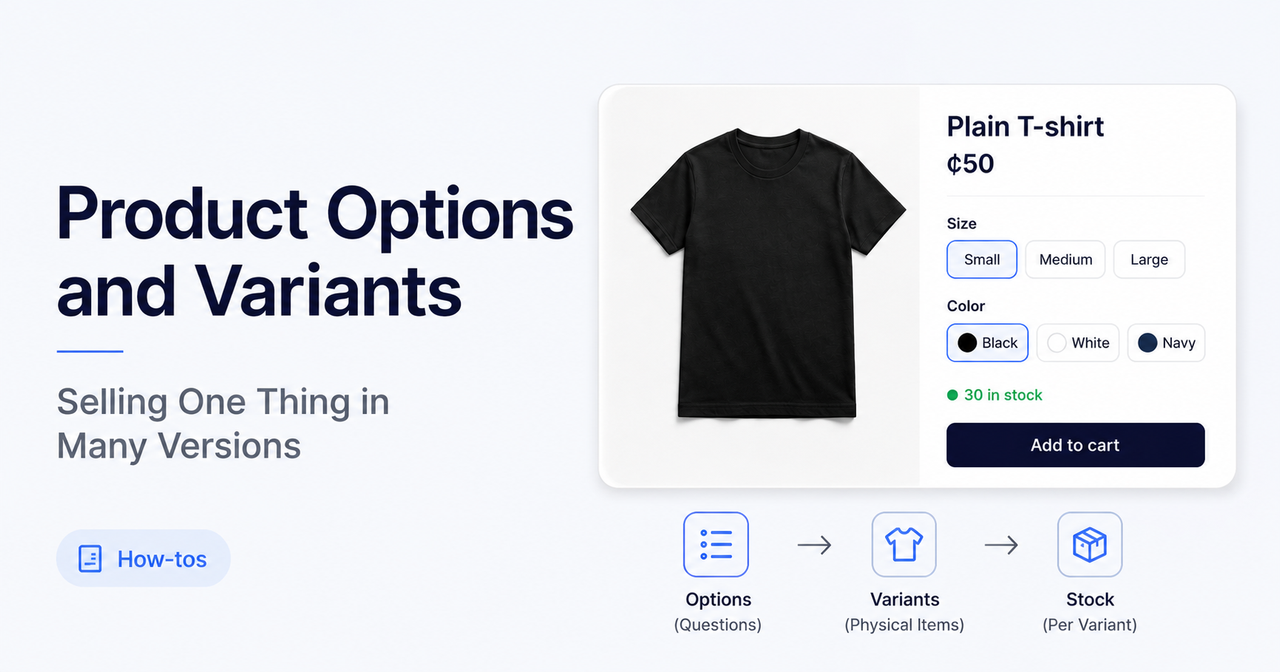
Your catalogue has limits. It is fine for a starter range, not for a real inventory with variants, sizes and colours.
You cannot sell while asleep. Every sale needs you present and typing. That is a hard ceiling on how much one person can sell.
You have no idea what is actually selling. No data on your best products, your repeat customers, or which items sit unsold for months.
None of that is a reason to leave WhatsApp. It is a reason to stop making WhatsApp do jobs it was not built for.
The Setup That Actually Scales
The sellers who grow past a few orders a day almost all end up doing the same thing. They keep WhatsApp for the conversation and move the shop part somewhere built for it.
In practice that means you have a store link with your full catalogue, real prices and proper photos. You send the link instead of forty images. Customers browse, choose, and pay by mobile money or card themselves, or choose payment on delivery. The order arrives as an actual order with a record, your stock updates itself, and you can see what is selling.
That is what Strawlo does. Your store runs from your phone, takes mobile money and card payments, handles payment on delivery, and tracks orders and stock. WhatsApp stays exactly where it is, as the place you talk to customers, except now you are answering questions instead of repeating prices.
Two things worth knowing once your store is running. You can message every customer who has ever bought from you with WhatsApp broadcast, from your own number, which is how restocks and sales actually move. And when someone starts an order and does not finish, you can follow up on WhatsApp rather than losing the sale silently.
Common Mistakes
Selling from a personal account. You lose the catalogue, quick replies and labels, and you look less serious.
Hiding prices. "DM for price" filters out far more buyers than it protects margin.
Sending photos with no prices. Every photo without a price generates another message you have to answer.
Releasing goods on a screenshot. Confirm on your own phone. Always.
Letting your customer list sit unused. Everyone who ever bought from you is a warm contact. Most sellers never message them again.
Mixing personal and business chats. Get a separate number if you can. Searching for an order among family chats wastes your time.
Posting status once a week. Consistency beats polish. Show up daily, even simply.
Frequently Asked Questions
Do I need a website to sell on WhatsApp in Ghana?
No. You can sell with WhatsApp Business alone. Most sellers eventually add a store link because answering the same questions manually caps how much one person can handle, but you do not need one to start.
WhatsApp Business or WhatsApp Business API?
The free WhatsApp Business app is right for almost every small and growing seller in Ghana. The API is built for large companies with support teams and automated messaging, and it involves cost and approval you do not need yet.
How do I get customers on WhatsApp in the first place?
WhatsApp converts attention, it does not create it. Bring people from Instagram, TikTok, Facebook or in person using your click-to-chat link, then sell them in the chat. If you are still deciding what to sell, our guide to fast moving items to sell in Ghana is a good place to start.
How do I stop people wasting my time?
Post prices publicly, state your delivery fee upfront, and use quick replies so answering costs you seconds. Most time-wasting comes from information you could have published once.
Is payment on delivery worth it?
It raises conversion, especially with new customers who do not know you yet, and it raises failed deliveries too. A small deposit covering the delivery fee is the usual compromise. Decide your policy in advance and apply it to everyone.
Can I use one number for two businesses?
You can, but labels and chats get tangled quickly. A second number is cheap and keeps each business legible.
Start With the Setup
Most sellers in Ghana are already on WhatsApp. Few have done the setup properly, and that gap is where the sales are.
Switch to WhatsApp Business, fill the profile, build the catalogue, write five quick replies, and make a click-to-chat link today. That is an hour of work and it will pay for itself this week.
Then, when you find yourself typing the same price for the twentieth time in a day, that is the signal. Not that WhatsApp is failing you, but that the shop part needs somewhere better to live.
Get weekly business tips
Join 1,000+ entrepreneurs growing their online businesses.
No spam, ever. Unsubscribe anytime.